Hidden pipe leaks in walls and ceilings
Moisture mapping and listening equipment help narrow the search before any access holes are made, which matters in finished basements and renovated rowhomes.
Serving Philadelphia, Pennsylvania & surrounding areas
24/7 Emergency Response
Find the source fast, limit water damage, and get a clear plan for what happens next in your home or commercial space.
When water shows up where it should not, the most expensive mistake is guessing. Our leak detection Philadelphia service focuses on locating the source accurately, then explaining what we found in plain language so you can make the right repair decision.
Leaks are not always obvious. A supply line can drip inside a wall cavity, a drain line can seep only when a fixture runs, or a slab leak can spread moisture far from the actual break. In Philadelphia's older housing stock, tight chases, plaster, and layered renovations can hide plumbing and make trial-and-error cuts especially costly. We use non-invasive methods first, confirm with targeted testing, and only recommend opening up surfaces when the evidence points to a specific area.
Water Damage Restoration Philly works with homeowners, property managers, and businesses across the city. If you already have wet drywall, bubbling paint, warped flooring, or a musty smell, you do not need a lecture. You need an answer: where is the water coming from, and what should happen next to stop it and prevent secondary damage.
Moisture mapping and listening equipment help narrow the search before any access holes are made, which matters in finished basements and renovated rowhomes.
We test fixtures and lines systematically—toilets, tubs, dishwashers, and ice makers—to separate a plumbing leak from condensation or roof-related water entry.
We distinguish plumbing leaks from groundwater intrusion signs so repairs address the real cause, not just the symptom on the surface.
In offices, retail, and multi-unit buildings, we focus on quick isolation and documentation so you can coordinate maintenance with minimal disruption.
If the water meter continues to run when fixtures are off, we help narrow whether the issue is on interior piping or a specific appliance line.
We start by listening to your timeline and symptoms, then build a simple test plan: where water is observed, what fixtures or cycles trigger it, and how far it has traveled. That plan matters in Philadelphia neighborhoods with dense attached homes, because water can migrate along shared party walls and show up one floor down or one room over.
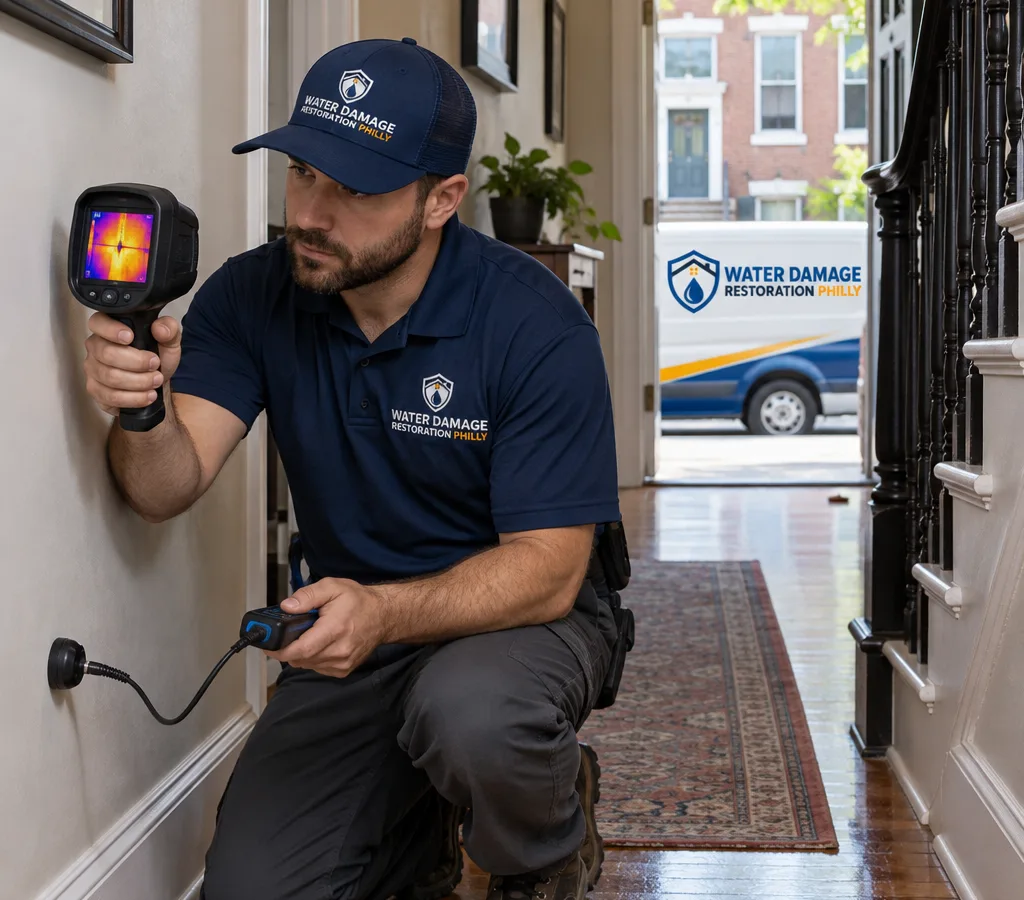
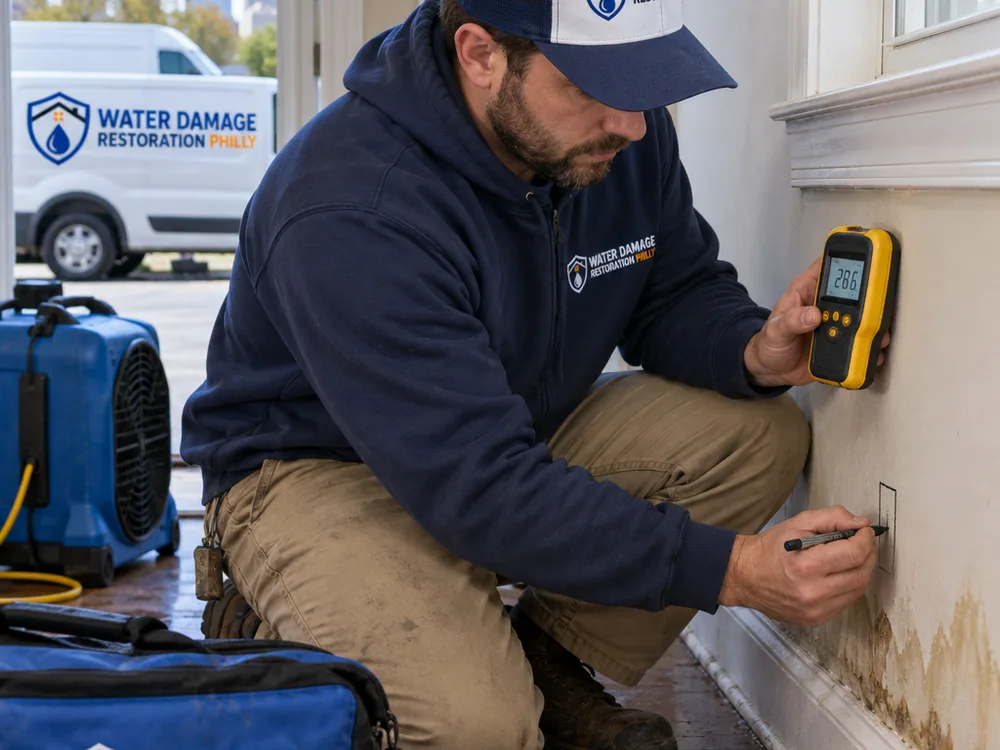
Non-invasive location comes first. Depending on the situation, we may use acoustic detection to follow pressurized line noise, thermal imaging to spot temperature differences created by moisture, and moisture meters to map the wet perimeter. For suspected drain leaks, we may use dye testing or controlled flow tests to see when and where water appears.
You will get a straightforward summary of what we found, what we ruled out, and the smallest reasonable access area to confirm the exact point of failure. If active water damage is present, you can also coordinate next steps through our water damage restoration in Philadelphia team so mitigation begins quickly once the leak is addressed.
Local examples where the approach matters:
We confirm what you are seeing—stain, odor, dripping, wet floor, or meter activity—and whether any immediate shutoff is needed to prevent further damage.
We run controlled fixture tests, check likely routes such as supply, drain, and appliance lines, and map moisture to understand how water is spreading.
Using evidence from meters, thermal imaging, acoustic equipment, and visual inspection, we narrow the source to a specific area rather than a general room guess.
You get a written, plain-English explanation of the suspected leak location, recommended access point if needed, and what must be repaired to stop the water.
If materials are wet, we can coordinate drying and cleanup planning right away so you are not waiting while damage worsens.
Leak detection in Philadelphia typically ranges from about $250 to $750 for a standard residential visit, with higher totals when the leak is intermittent, access is difficult, or multiple areas must be tested. A straightforward visible-source confirmation may be on the lower end, while slab, multi-story, or commercial troubleshooting can run $750 to $1,500+.
Final price depends on how long testing takes, whether specialized tools are needed—thermal imaging, acoustic location, or dye testing—the number of fixtures or lines involved, and whether documentation is required for a property manager or insurer. Exact cost is confirmed after the on-site evaluation and testing plan are set.
Philadelphia homes and mixed-use buildings often have details that change how leak detection should be done:
A repaired ceiling may hide multiple generations of piping. We verify what is active now instead of assuming an old route.
In attached properties, water can travel along framing and show up in a neighbor's unit or a different stack. We focus on source confirmation, not just where staining appears.
Many basements have exposed runs in some sections and finished walls in others. We use mapping to avoid opening finished areas unnecessarily.
If you are dealing with active water spread, the priority is to stop the leak and stabilize the affected materials. If the property already needs drying, odor control, or material removal, you can coordinate that work through Water Damage Restoration Philly after the leak source is identified, so you are not managing multiple unknowns at once.
Tell us what you are seeing and where it is showing up. We will schedule an on-site leak detection visit in Philadelphia and provide clear findings and next steps so repairs and restoration can move forward without guesswork.